

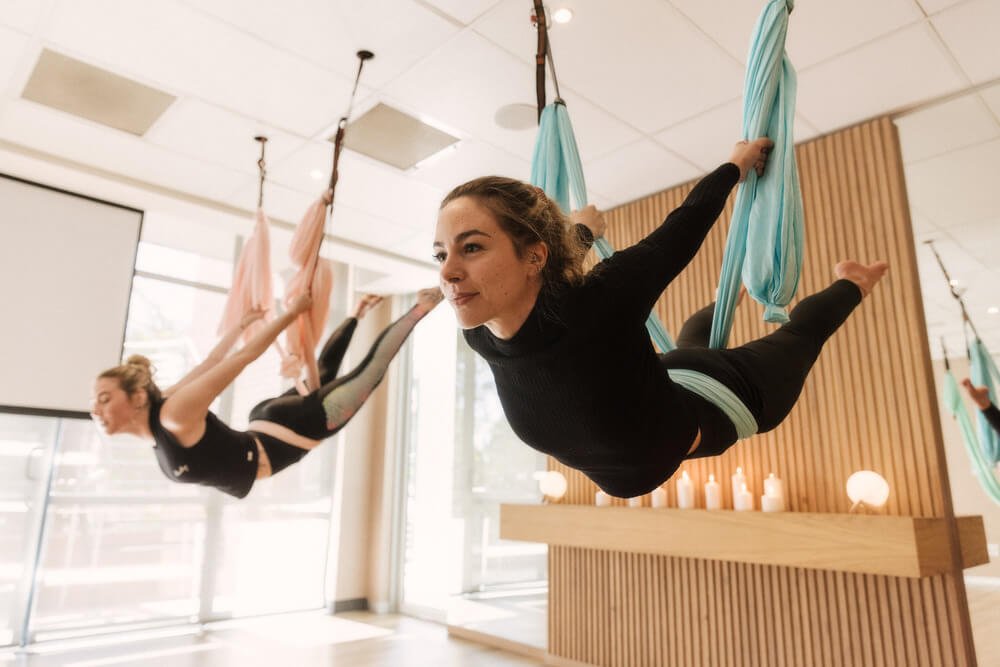
A fitness routine becomes more useful when it teaches the body something new. Many adults repeat the same movements every week, yet still feel stiff, unbalanced, or disconnected from their body. This is why aerial yoga is gaining interest among people who want a practice that challenges balance, mobility, and awareness in a different way from standard mat-based movement.
Aerial yoga uses a hammock to support, suspend, and guide the body. This changes the way students experience movement. The floor is no longer the only support system. The hammock becomes a moving partner. Because of this, students must pay closer attention to alignment, breath, weight distribution, and control. The result is a practice that can feel playful, technical, and deeply physical.
Why Suspension Changes the Body’s Response
On the ground, the body understands stability easily. The feet, hands, knees, or back press into a firm surface. In aerial yoga, the body often works with a support that moves. This creates a different challenge.
The student has to control the body against swinging, shifting, or uneven pressure. Even simple movements can become more demanding because the support is unstable. This encourages the core, hips, shoulders, and grip to work together.
Suspension also changes how the body senses space. When a person is partly lifted or inverted, they must understand where their limbs are without relying only on usual floor contact. This improves body awareness.
Balance Is Built Through Micro-Adjustments
Balance is not a fixed skill. It is created through constant micro-adjustments. In aerial yoga, the hammock gives immediate feedback. If the body leans too far, grips too tightly, or loses core engagement, the movement feels unstable.
This feedback teaches students quickly. They learn how to distribute weight, stabilize the center, and move with less force. Over time, the body becomes better at adjusting.
This kind of balance training is useful because daily life also requires constant adjustment. Walking, carrying bags, climbing stairs, and reacting to sudden movement all depend on balance and coordination.
Mobility With Support
Many people struggle with mobility because they feel restricted by gravity. On the mat, a pose may feel too intense or difficult to access. The hammock can support part of the body, allowing students to explore movement with less fear.
For example, supported hip openings, spinal lengthening, and assisted backbends may feel more accessible with the hammock. The fabric can help students find space in the body without forcing the movement.
This support is especially useful for people who feel stiff but want a practice that does not feel limited to basic stretching.
The Importance of Controlled Entry and Exit
In aerial yoga, entering and exiting a pose matters as much as holding it. A rushed transition can create swinging or discomfort. A controlled transition builds strength, awareness, and safety.
This teaches students patience. They cannot simply throw themselves into a position. They must understand the wrap, the grip, the breath, and the direction of movement.
This slow learning process is one reason aerial yoga can improve concentration. The mind has to stay present.
Core Engagement in Unstable Positions
Aerial yoga often reveals whether the core is truly active. When the body is suspended, weak control becomes obvious. The student may swing, collapse, or rely too much on the arms.
Core engagement helps stabilize the pelvis and spine. It also allows the limbs to move more smoothly. This is not about doing endless abdominal exercises. It is about learning how the center supports the whole body.
Students may notice that even gentle aerial movements can create deep core fatigue because the body is constantly stabilizing.
Shoulder Awareness and Upper-Body Control
Many aerial movements involve the arms and shoulders. Students may hold the hammock, pull the fabric, or support body weight. This can improve upper-body awareness, but it also requires care.
The shoulders should not be forced into unstable positions. Students need to learn how to engage the back, keep the neck relaxed, and avoid hanging passively from the joints.
Good instruction is important because the hammock can make students feel adventurous. Safe technique keeps that adventure useful rather than risky.
Why Aerial Yoga Can Improve Confidence
Trying suspended movement can feel intimidating at first. Many students worry about falling, getting tangled, or not being strong enough. But the practice is usually built step by step.
As students learn basic wraps, supported poses, and controlled transitions, confidence grows. The body starts to feel capable in unfamiliar positions. This can be especially powerful for adults who have lost confidence in movement.
Aerial yoga can make people feel playful again. That sense of play is often missing from adult fitness routines.
Body Awareness Beyond the Studio
The awareness built in aerial yoga can carry into daily life. Students may become more aware of how they stand, where they hold tension, how they grip, and how they react when balance is challenged.
This matters because many adults move through life on autopilot. They sit, walk, work, and exercise without noticing patterns. Aerial yoga interrupts autopilot. It asks for attention.
Over time, this attention can improve movement quality in other activities.
Why Breath Is Essential in Suspended Practice
Breath becomes especially important when the body is in unfamiliar positions. Some students hold their breath when they feel nervous or when the hammock pressure feels intense. Breath helps regulate the experience.
A slow breath can calm the nervous system. It can also help students move into poses with less tension. When the breath stays steady, the body often feels more controlled.
This is why aerial yoga is not only physical. It also trains the mind to stay calm in new situations.
Choosing the Right Aerial Yoga Class
Students should choose classes that introduce the practice gradually. A good class should explain how to use the hammock, where to place the fabric, how to enter positions, and how to come out safely.
People should not feel pressured to attempt advanced inversions immediately. A strong foundation matters more than dramatic poses.
Aerial yoga is best learned in a studio environment where guidance, equipment safety, and class structure are taken seriously.
For those who want to explore movement that challenges balance, mobility, and awareness in Singapore, Yoga Edition can be part of a structured practice where aerial yoga is approached with care, curiosity, and proper guidance.
FAQs
What happens if I get stuck in the hammock?
Stay calm and tell the teacher immediately. Most “stuck” moments are simple fabric placement issues. Avoid pulling randomly, as that can make the wrap tighter or more confusing.
Can aerial yoga help if I am afraid of going upside down?
It may help gradually, but you should not force inversions early. Start with low-height supported poses and build trust with the hammock before trying upside-down movements.
Why do my hands feel tired during aerial yoga?
Grip fatigue is common because the hands and forearms work more than in regular mat yoga. Over time, grip endurance may improve, but you should rest if your hands feel weak or shaky.